What you should know
Grey spot corrosion occurs as a sign of wear on the surfaces of metal components that are constantly subjected to high loads. This primarily affects gear wheels in gearboxes and the sliding camshafts and tappets in valves. Damage of this kind rarely occurs in motor vehicle gearboxes, but mainly in industrial plant such as mill drives, rolling mills and wind turbines.
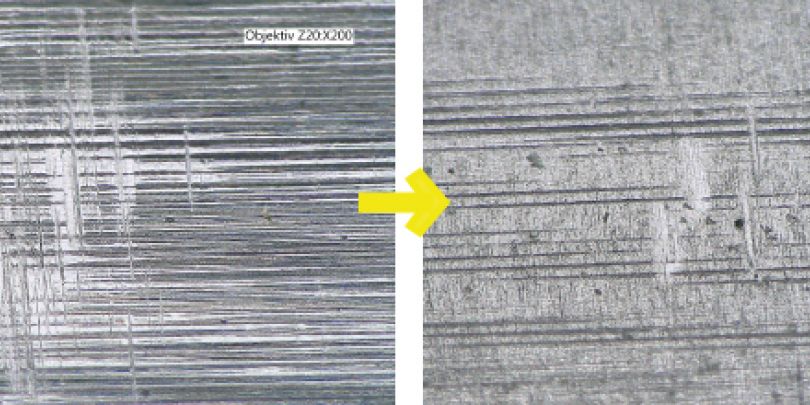
When viewed with the naked eye, the damaged parts appear matt grey. It is only under high magnification that it becomes apparent that numerous tiny pores and spalling are responsible for the grey colour. In gear wheels, under constant high load, sliding and mixed friction occurs at the points of contact. This causes plastic deformation, resulting in microscopically small cracks. These can develop into deeper cracks and subsequently into larger spalling. This phenomenon is also known as pitting. Over time, grey mottling can adversely affect the flank profile of gear wheels and alter both the meshing dynamics and the noise behaviour within the gearboxes.
Grey pitting can have various causes. It occurs primarily when components such as gears are subjected to sustained heavy loads and there is a high sliding speed combined with a thin lubricating film. The thin lubricating film is often the result of the lubricant being exposed to high temperatures. Another reason may be an unfavourable gear geometry, which leads to high loads at specific points on the tooth flank. The nature of the surface also plays a role. If the surface is very rough, a lubricant film that is too thin will result in constant metal-to-metal contact and thus friction damage.
The choice of lubricant is also crucial, as the gear geometry, rotational speeds and loads are determined by the requirements of the specific gearbox design. If the viscosity is too low, for example, this results in insufficient lubricating film thicknesses. Furthermore, certain additives in the oil can promote corrosion and thus the tendency for grey spot formation. Today, high-performance lubricating oils are tested using a standard test to determine whether they are suitable for preventing grey spot formation.
However, there is another theory regarding the cause of grey pitting. In the 1970s and 1980s, the car manufacturer Mercedes-Benz observed signs of wear on the rear-axle gear assemblies. Following various metallographic tests in their in-house laboratory, the engineers concluded that the lubricating film was destroyed by vibrations with unusually high natural frequencies of the components, which subsequently led to galling damage on the gear flanks. This explanation could also apply to the roller bearings in wind turbines. This would mean that the wear is not caused by external loads, but by dynamic stress within the gearbox components themselves.
Grey pitting has been a known issue in gearboxes for many years. It occurs particularly frequently in wind turbines and therefore poses a major problem for operators. On the one hand, it can have a lasting impact on the output of wind turbines; on the other hand, gearbox damage caused by grey spot can quickly run into six-figure sums. Above all, it remains unclear who is liable for such damage.
In 2007, the German Wind Energy Association (BWE) set up a working group comprising experts, operators, technical managers of wind turbines and lawyers to investigate the causes and effects of grey mottling, as well as appropriate countermeasures. It took four years for the commission to present its final report in 2011. The conclusion: it remains unclear who can be held liable for damage caused by ‘grey spotting’. Gearbox manufacturers regard the problem as normal wear and tear, which is excluded from warranties. The process of grey spot formation is very slow and usually only leads to gearbox failures once the warranty period has expired. To date, the courts have not clarified who is liable for the damage.
Until the causes have been established, there will be no final decision on who is liable for damage to the gearboxes of wind turbines. High-performance wind turbines with a capacity of more than one megawatt, which are constantly operating at their limits, are particularly affected. The problem of grey spotting can only be partially mitigated using conventional lubricants and improved surface structures: the older the turbine, the more difficult it is to find a satisfactory solution. It therefore remains to be seen whether the phenomenon of grey spotting will be recognised at all as damage giving rise to a right of recourse. The BWE working group has therefore not reached a definitive conclusion in its report. To date, there is insufficient experience regarding the fatigue strength of large wind turbines and the effects of dynamic forces – such as fluctuating winds, wind shearing or tower shadows – on the drive shafts.
The very best approach, therefore, is to protect new wind turbines from grey spot formation right from the start through innovative nanotribology, and to rule out the dreaded pitting as a result of this damage from the outset. However, even the highest-quality lubricants cannot achieve this, as, sooner or later, they too can only reduce frictional wear but cannot eliminate it entirely. A far more effective approach is to treat the surfaces directly and apply a metal-ceramic coating to them, thereby largely avoiding frictional forces. Surface ceramicisation is achieved through the use of the oil additive DuraGear® W100. This is added to the lubricant whilst the machinery is in operation; it uses the lubricant as a carrier to reach points of friction, where, through a chemical process, it deposits silicates onto the metal surfaces, thereby transforming them into metal-ceramic surfaces.